Editorial: The AI Conundrum – Feature: Know Thy Multimeter
From the Masthead
The AI Conundrum
Hardly a day goes by that I don’t receive an email from a client or reader, posing a question, and then sharing what he or she has already learned about the subject from AI. In other cases, the query goes something like this, “Steve, you said XXX in an article you wrote about exhaust systems, but AI says that’s wrong, and not ABYC compliant”. It can be at once a frustrating and enlightening experience, and AI, by the way, because it resides behind a paywall, does not have direct access to ABYC Standards; more on this below.
Of this there is no doubt, AI is here to stay, some have likened it to this century’s Industrial Revolution, it is affecting our lives more with each passing day. We have yet to even conceive of the changes, and challenges, that it will bring in the years, and even months, to come. However, like any technology, it represents the proverbial double-edged sword. Over eight in 10 Americans don’t fully trust what AI tells them, and they opt to still explore original sources by themselves, according to new research. That’s somewhat surprising to me, and a little comforting, people are rightfully skeptical. When I taught navigation and systems at the US Naval Academy’s Sailing Program, I was amazed at how quick young midshipmen and women were to embrace, without question and at face value, everything they were being told by flat screens. I would often have to say to them, ‘get up, and look outside; make sure the screen matches what your eyes are seeing outside’.
While many are using it, some cautiously, others more embracing it wholesale; I have colleagues who refuse to even communicate with someone who is citing AI in a technical discussion, and I can understand his reticence; AI is often wrong, or it is tasked incorrectly, and thus dispenses inaccurate information, and AI can hallucinate… it can provide totally false information, albeit in a very convincing fashion. I had just such an encounter recently, as my wife and I were walking around the town square after dinner, the movie, ‘The Deer Hunter’ came up. I said, “Yes, with Robert DeNiro”. My wife said, “No, he wasn’t in that movie, I’m sure of it”, and so, like so many arguments are now settled, I asked AI for the cast of ‘The Deer Hunter’, and Robert DeNiro wasn’t among them. I was shocked, she gloated, but then I asked the question again, and this time the cast included DeNiro, along with Christopher Walken, John Savage, Meryl Streep and John Cazale.
I use AI for technical queries almost every day, with caution. I have found, if you have a good working knowledge of the subject, you can identify responses that are fully flawed or just not quite right. I also find that if the question is rephrased, this helps, as does a review of the source links (in many cases, sources are articles I’ve written, and I’m not beyond making errors); if it’s solely Reddit, for instance, I’m more skeptical. Especially noteworthy, I routinely encounter AI errors related to ABYC Standards. As noted above, public AI engines do not have access to ABYC Standards, and as a result, responses related to ABYC Standards are gleaned from a variety of sources, some are accurate, some are otherwise.
“A Luddite is someone who is opposed to technological change, particularly in the context of how it affects jobs and working conditions. The term originated from a 19th-century movement of English textile workers who protested against the introduction of automated machinery.”
The marine industry, boat builders and owners, we all need to learn how to utilize AI to our best advantage, while being wary of the pitfalls; I’m convinced there is a beneficial middle ground, over which we need to proceed with caution and a healthy dose of skepticism. My advice to those using AI, stand up, and look outside every once in a while.
This month’s Marine Systems Excellence eMagazine feature covers the subject of digital multimeters, it’s the first in a multi-part series. I hope you find it both interesting and useful.
Know Thy Multimeter
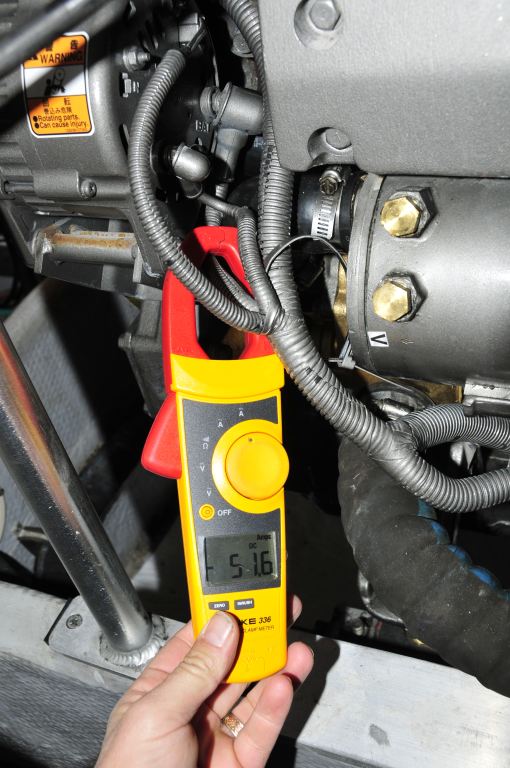
The clamp or “jaws” feature, used for measuring current, or amps, is a must have option for any digital multimeter, and it should work with both AC and DC, and ideally at least up to 400 amps DC.
What’s the most useful tool you have aboard when it comes to electrical troubleshooting, after your brain (and AI?) that is? In decades past it used to be the twelve-volt test light. When I first began working as a marine mechanic and electrician, I used mine so often I had to replace it every year or two. Today, however, the humble test light has been replaced by the now-ubiquitous digital multimeter (or DMM). If you’ve never seen a test light, and many young technicians have never seen, much less used one, it looks like a screw driver, or more accurately an awl because the tip is pointed, with a light bulb in the clear plastic handle, to which a long cord with alligator clip is attached. While I still have mine, I haven’t used it in years, although it remains a simple and reliable back up to the more sensitive and easily damaged DMM, for testing non-electronic DC circuits that is. There are some circuits on which conventional incandescent test lights should not be used.
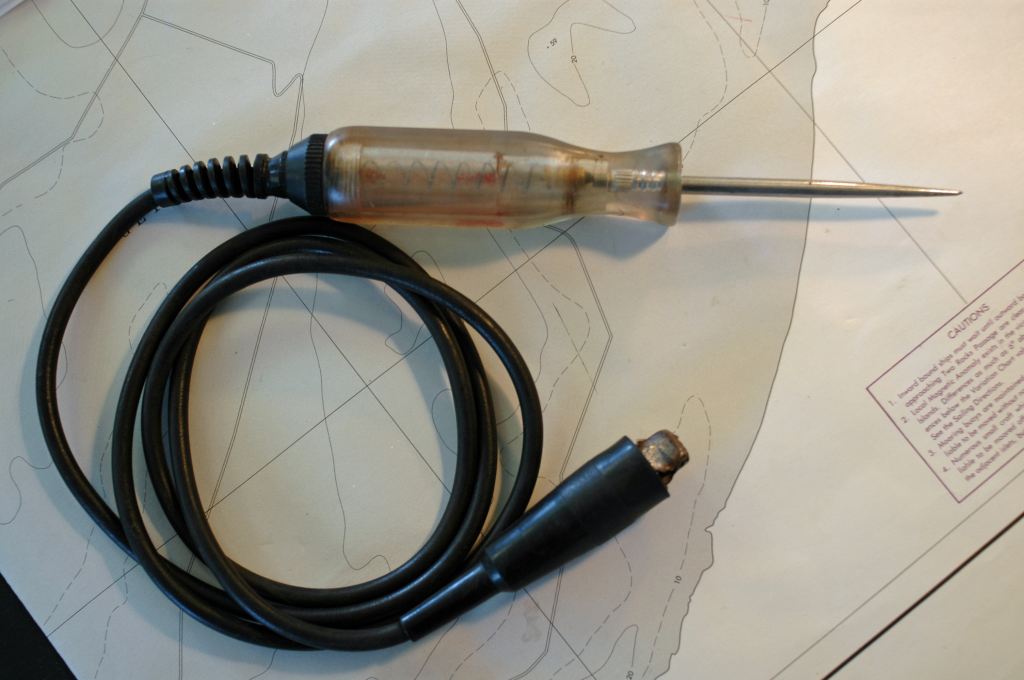
The humble 12-volt test light. In its day, it was the primary test tool used by marine electricians. Today, however, most have been discarded, or they gather dust in the back of roll away draws; long-since replaced by the DMM.
When a client contacts me with an electrical problem or troubleshooting scenario, one of my first questions is, “Do you have a DMM, and if so, do you know how to use?” Even if you aren’t sure how to use one, having a DMM aboard makes good sense for two reasons. One, if you don’t know how to use one, someone else aboard or nearby may have the necessary understanding and experience to do so. Two, if you don’t have one aboard, one thing is certain; you’ll never learn how to use it, and if there is someone nearby who does know how to use it, his or her knowledge is of little good without the tool. However, be assured, they are relatively simple to operate, and the wealth of information they provide is virtually limitless.
While they come in a wide variety of shapes and sizes with different capabilities and features, with ranges to match, the good news is most work the same way and even an inexpensive one will do nearly everything the average do-it-yourself cruiser could ever hope for when troubleshooting common onboard electrical faults.
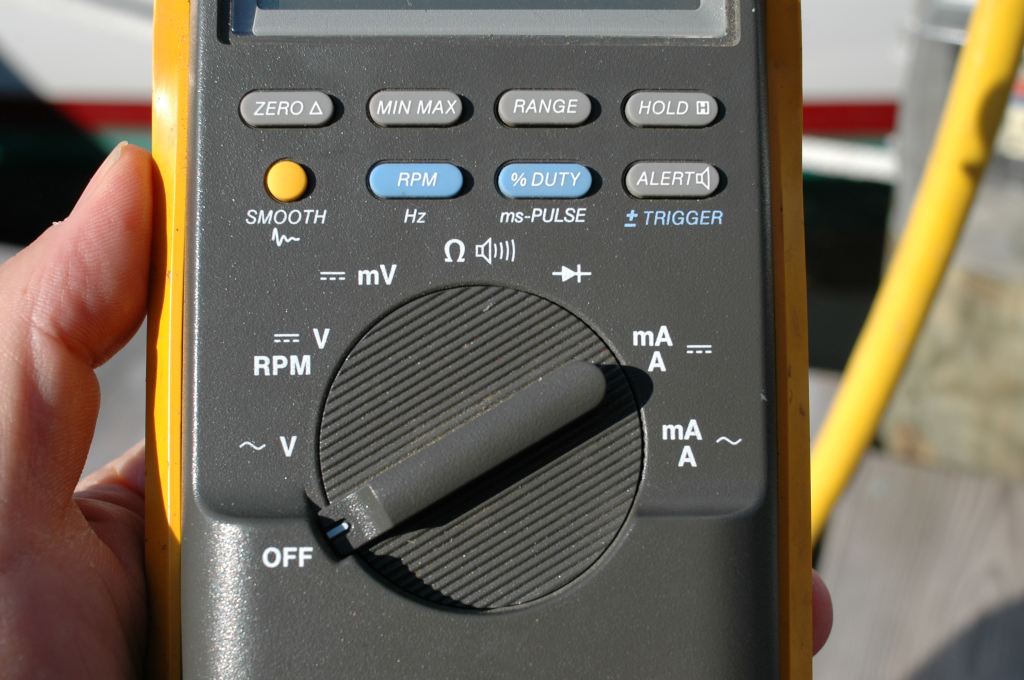
The DMM’s control panel (this is my first Fluke, purchased in 1989, and still going strong) pictured above includes a variety of features. Clockwise from OFF they include AC power voltage measurement for shore power, generator and inverter work; DC voltage measurement for battery, alternator and primary onboard electrical components, this meter will, with an optional attachment also measure rpm for gasoline engines; mV is the millivolts scale or thousandths of volts DC, this is used for, among other things, to troubleshoot corrosion issues; the Ω symbol represents ohms or resistance, the list of its uses is virtually endless, however, it can be used for identifying poor connections and in evaluating the bonding system; The arrow striking a wall symbol represents the diode test feature, which could be used to evaluate, well, a diode or your galvanic isolator equipped shore power system. The mA A represents the DC ampere and milliamp scale (milliamps are thousandths of an amp) which is a measurement of current or amperage, it’s useful in determining how much current a piece of equipment is drawing… a light, fan or motor for instance, although with more modern meters this function is measured with an inductive amp clamp or “jaws”; the mA A scale is AC, once again power from shore, a generator or inverter, amperes, which you might use to determine how much current an AC appliance such as a pump or battery charger is drawing and thereby determine if it’s working correctly.
Finally, the blue “RPM/Hz” button allows for the measurement of spark ignition engine rpm, using an external clamp, or frequency/Hz. The latter is primarily used to confirm generator output frequency, which is related to rpm, 60 Hz in North America, and 50 Hz in much of the rest of the world. If a genset’s rpm is incorrect, most 60 Hz diesel units operate at 1800 rpm, and gasoline models at 3600 rpm, the output frequency will be affected.
In upcoming columns I’ll delve into specific troubleshooting tasks for this all too useful tool, as well as techniques for measuring amperage, voltage and resistance. Stay tuned.