
From the Masthead

“That’ll Void your Warranty”
It’s something I hear often, often from engine and equipment dealers, and even some manufacturers, “If you do that, it will void your warranty”. But will it?
The first time I encountered this “line” was at a boat show. An engine dealer had a sign in front of their booth that essentially said that if owners of the engines they sold didn’t use a fuel additive, one they were selling, their warranty could be voided. The booth I was working was nearby, so I quickly made my way over to them and began asking questions. The issue revolved around potential lubricity issues associated with the introduction of Ultra Low Sulfur Diesel or ULSD (High sulfur diesel can contain up to 5,000 ppm, low sulfur no more than 500 ppm, and ultra-low sulfur no more than 50 ppm). When ULSD was first introduced to fuel docks, there was a great deal of misunderstanding and some panic. It was being reported that sulfur was a lubricant, and with its reduction from 5,000 or 500 ppm, to 50 ppm, engines’ fuel injection systems could suffer from accelerated wear. In truth, sulfur as a diesel fuel ‘lubricant’ is a widely-held myth; in fact, the removal of sulfur, using a process known as hydro-treating, can also reduce lubricity; making sulfur removal and lubricity indirectly related. Typically, after the removal, diesel fuel is dosed with a lubricity enhancer, sometimes at the refinery, and sometimes at the fuel distribution rack, often using 2% biodiesel, to return it to the necessary level of slipperiness. Is there a risk of getting diesel that has insufficient lubricity, and is there a benefit to using a lubricity enhancer, just in case? In my experience the answer to both questions is yes, however, a dealer mandating its use amounts to a scare tactic (and do you think tens of thousands of over the road diesel trucks are using an additive with every fill up?). Most engine manufacturers do mandate a minimum lubricity level, and if the fuel you are using fails to meet it, then it’s up to the user to treat the fuel, to bring it into compliance.
Magnuson-Moss Warranty Act
Enacted in 1975, this law governs the language and requirements for consumer warranties; it applies to all consumer products, including automobiles and recreational vessels. Among other things, it ensures that consumers aren’t required to use specific brands or services, to maintain warranty coverage, unless the manufacturer provides these, at no charge. This means, a manufacturer can’t decline warranty coverage solely because you failed to use a fuel additive they sell. They can, however, decline coverage if they are able to prove a fuel system failed as a result of using fuel that failed to meet their required specification, including lubricity.
Another common ‘that’ll void your warranty’ example is filters, engine manufacturers can’t require you to use their oil and fuel filters to maintain coverage, but they can and often do, require performance specifications for filters from other manufacturers.
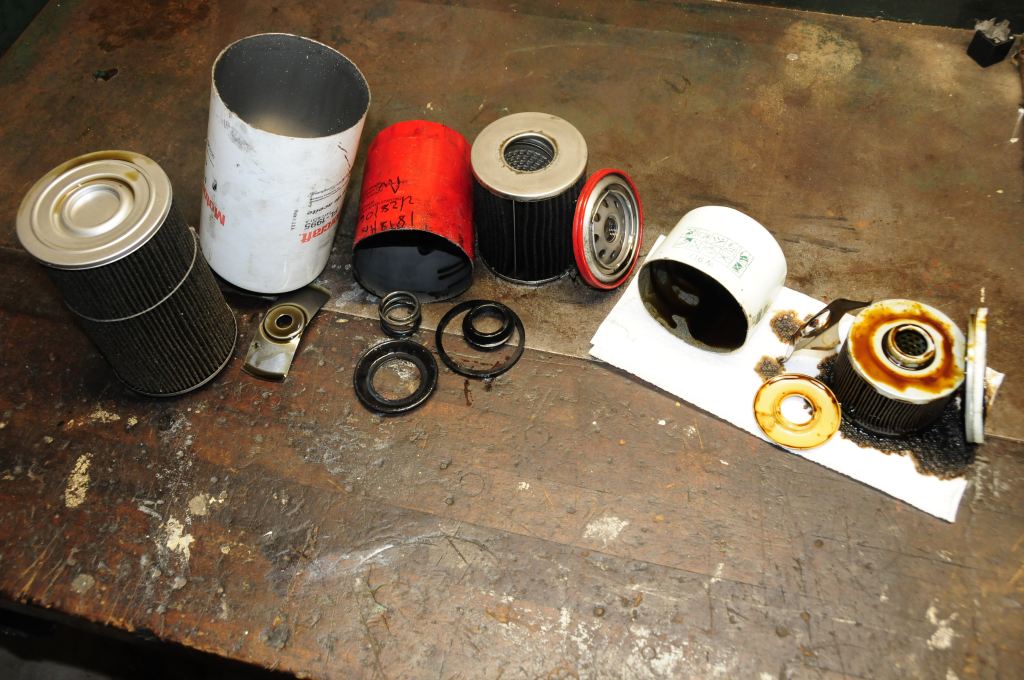
I’ve cut open and inspected scores of oil and fuel filters (I have a tool designed specifically for this task). I have found that some after-market filters, specifically those from Donaldson, WIX XP, and Fleetguard (which incidentally is owned by Cummins), to be of superior quality when compared to some original equipment manufacturer (OEM) brands. I had a case a few years ago where an OEM fuel filter caused a catastrophic fuel injection system failure, and the problem was not an isolated issue, it extended to multiple replacement OEM filters. After the repair was complete, and we verified the filter as the source of the problem, with lab analysis, the manufacturer, which covered the repair under warranty, approved the use of Donaldson filters as an immediate preventive measure.
Additionally, the Magnuson-Moss Act prevents manufacturers from skirting warranty coverage if you use a non-approved part, one that has no demonstrable relationship to the failure. For example, an engine manufacturer can’t deny coverage, if an oil pan develops cracks, because you used a non-original equipment fan belt or spark plug wire (and these may even be of a higher quality than the OEM version), that didn’t fail, or can’t be clearly demonstrated to have caused the failure.
Having said all that, the last thing I want to do is sue a huge engine manufacturer in federal court over a claimed violation of the Magnuson-Moss Act. What’s a vessel owner to do? Find balance, don’t let dealers claim you need to use costly OEM parts to maintain coverage, and don’t let them deny coverage for a failure because of a wholly unrelated part or issue. I’m not saying don’t use OEM parts, by all means do so, but you might also choose to use the highest, or even higher, quality after-market products as well.
This month’s Marine Systems Excellence eMagazine covers the subject of raw water check valves. I hope you find it both useful and interesting.
The Many Weaknesses of Raw-Water Check Valves
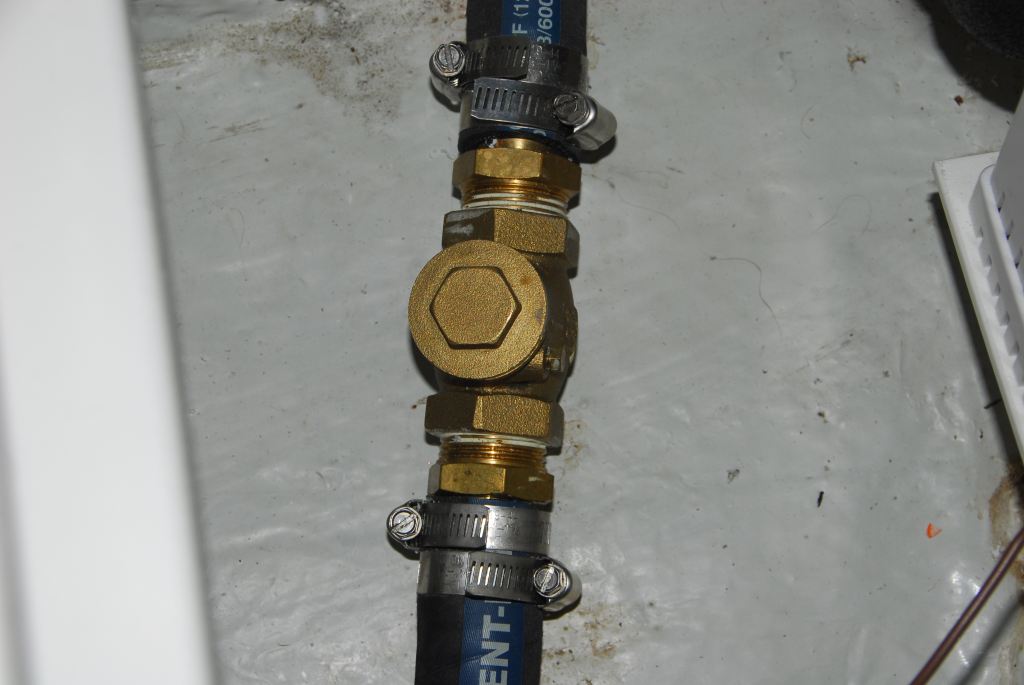
Ubiquitous though they are, the limitations of raw water check valves are many and varied.
Check valves are designed to prevent water flowing in one direction while moving somewhat freely in the other direction. These valves are found in many onboard systems, including sanitation systems, in a variety of raw-water plumbing applications from air-conditioning to sink drains, and in many (too many) bilge-pump plumbing runs. In my experience, too much reliance is placed on check valves to prevent flooding.
The most common is the swing check valve. Most often made from bronze (they are available in stainless steel; however, these are prone to crevice corrosion when used with raw water), with and axle that is often made from brass; it uses a metallic gate or door that freely opens when fluid flows in one direction and slams shut when fluid attempts to flow in the opposite direction. In most cases, these should be installed close to the horizontal plane to work properly, and with the pivot point at or near the top; most don’t include that information. If they are installed vertically, or diagonally, they must be oriented so that the door opens in the intended direction of flow. This style of valve is prone to axle failure, either from corrosion or wear, especially when used in systems that run often, like air conditioning.
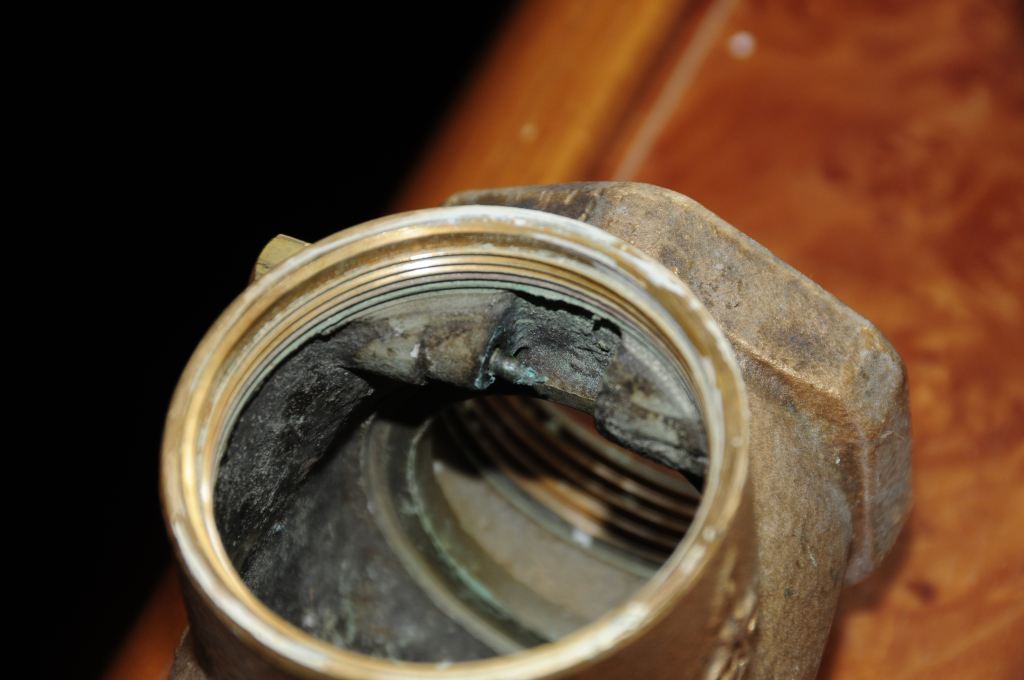 The ‘guts’ of a swing check valve, used in an air conditioning system, with the gate or door removed for the photo. This one’s corroded/worn out “axle” (often made from brass) allowed the gate to fall into the water stream, restricting water movement, as well as preventing it from checking flow.
A variation on this theme utilizes a plastic body and a rubber gate. Essentially it works the same way: water flow and pressure actuate the gate/flap to move it into the open or closed position, keeping it there as long as pressure is present. The non-metallic valves avoids the problem of corrosion-induced sticking, where the bronze check valves gate sticks to the valve body because of the formation of verdigris on the bronze sealing surfaces.
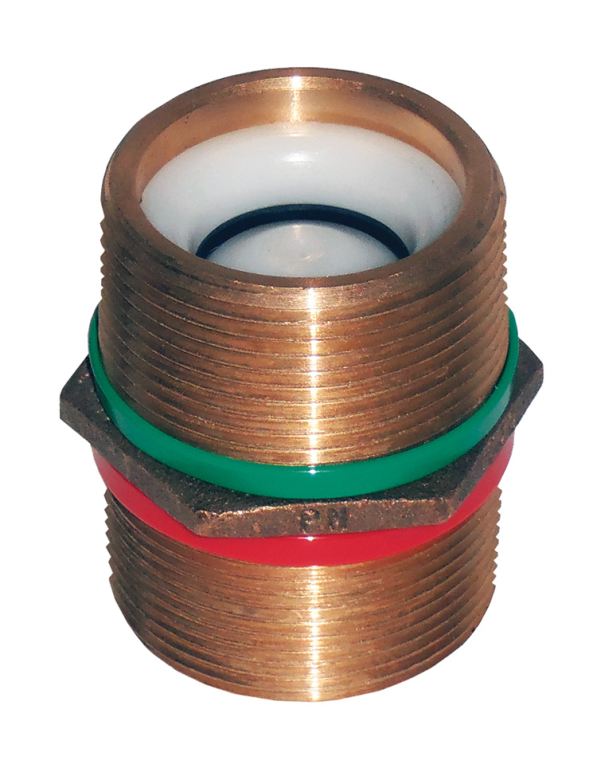
These spring-loaded check valves utilize a bronze body, plastic “gate” and rubber seal. Flow restriction is very low (Photo courtesy Groco).
In yet another style of check valve, water pressure compresses a spring-loaded disc in the fluid stream, pushing the disc back into the valve body and opening a path for the water to flow around it; flow restriction with this design is very low. If water attempts to flow in the other direction, the disc is forced up against a mating surface, creating a seal. The disc is plastic and the sela is made from rubber, so it avoids the above-mentioned sticking issue.
It’s important at this point to draw a clear distinction between check valves and antisiphon valves (see related articles Anti-Siphon Valves and Flooding vs. Siphoning). Whereas check valves are designed to prevent water flow in one direction, antisiphon valves break or upset naturally occurring siphon action. The confusion between the two is understandable since they are often used interchangeably to affect the same end—preventing fluid, typically seawater in the case of an antisiphon valve, from flowing in an unwanted direction. The manner in which they operate, however, could not be more different. Interestingly, most anti-siphon valves incorporate a check valve to allow air to enter, but prevent water from exiting the vent fitting.
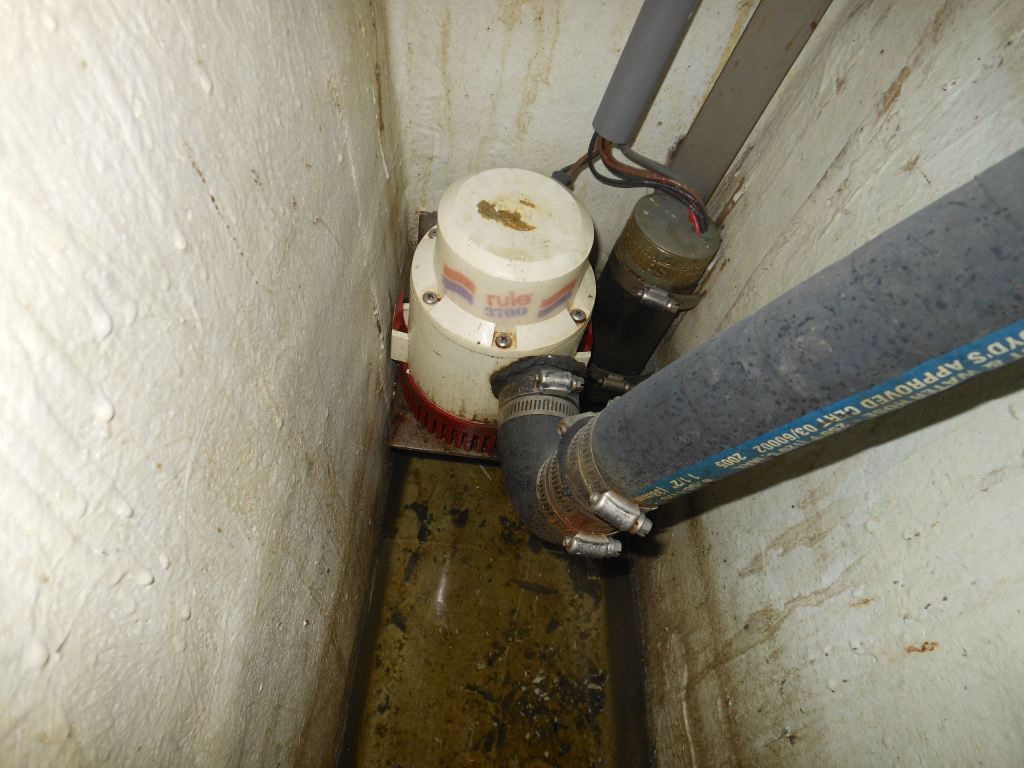
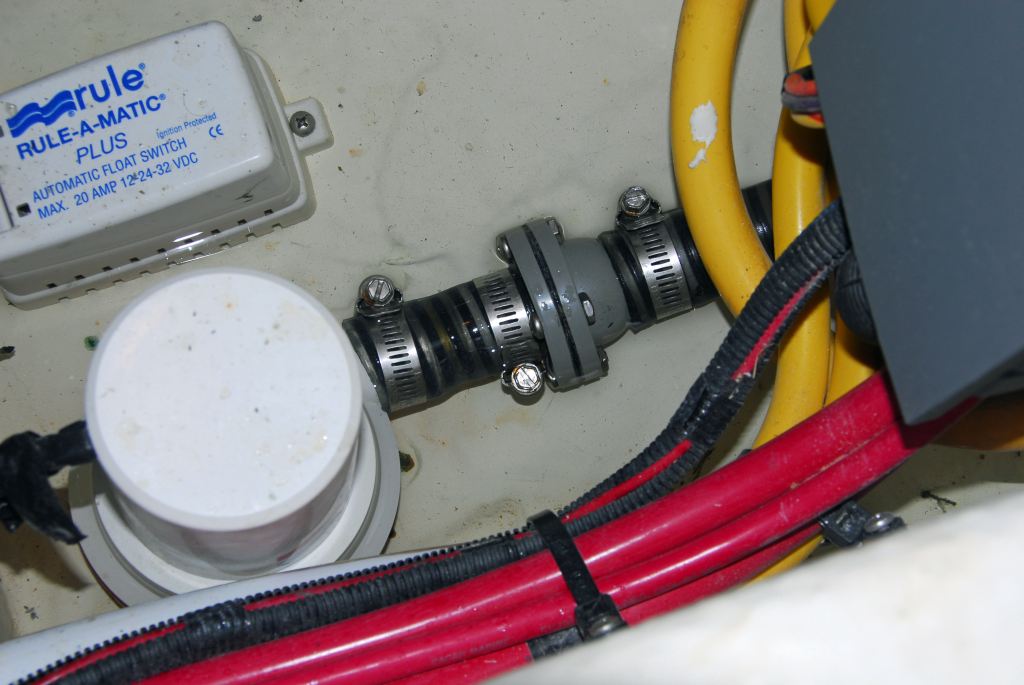
A large-diameter hose, a deep bilge, a submersible pump, and an in-line check valve (visible in the center of the image, retained by hose clamps) can be a recipe for failure.
It’s easy to see why check valves are so commonly used (and misused) for raw-water systems. In their favor, they are convenient and present a neat solution.
There are, however, three problems. One, check valves are prone to jamming in the open position, or failing all together when the gate’s axle wears out or corrodes, at which point the gate remains partially open, and restricting flow, thereby becoming an uncheck valve of sorts. Two, they are prone to jamming in the closed position, the most common failure mode, preventing water flow all together. Three, they can and almost always do restrict water flow even when working properly, the American Boat and yacht Council (ABYC) Standard H-22, Electric Bilge Pump Systems weighs in on this subject, saying…
NOTE: As installed, pump discharge capacity may be reduced by such factors as:
- head and length of discharge piping,
- number and radius of bends,
- roughness of the interior surfaces of piping and fittings, and
- reduction in cross-sectional area of discharge system components such as check valves and thru-hulls.
Emphasis is mine.
In experiments I’ve conducted I’ve measured as much as a 50% reduction of water flow when a check valve is installed and working properly, i.e., it’s fully open. This can be particularly problematic for bilge pump applications.
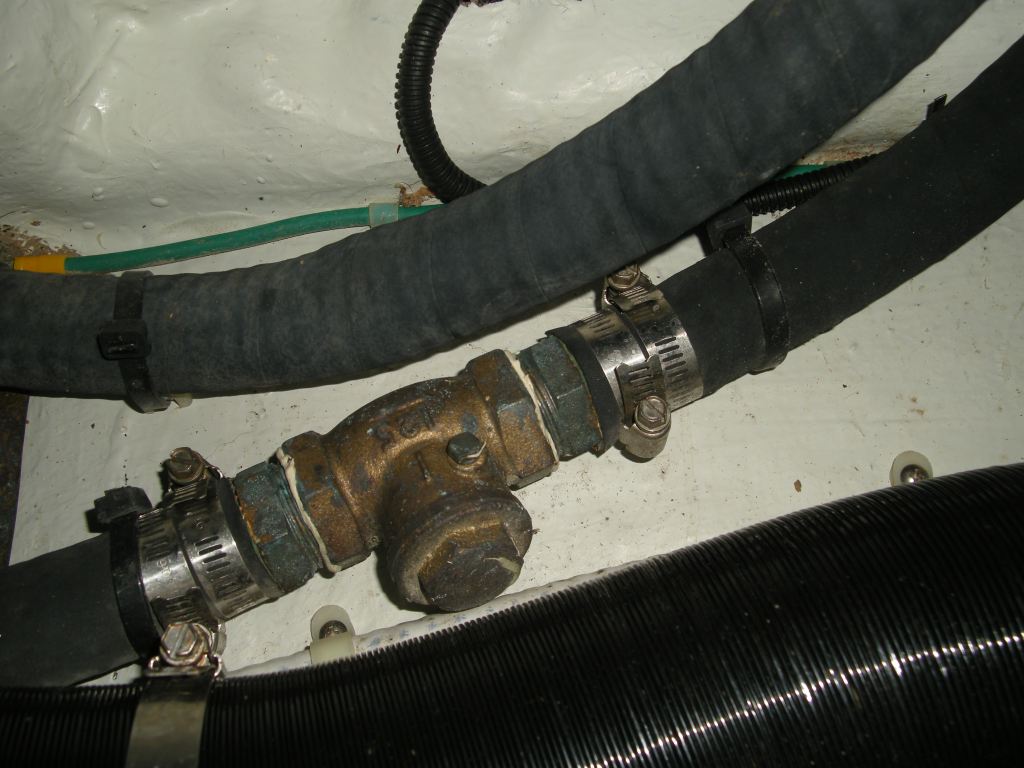
Traditional “swing” check valves have orientation limitations. While the gate opens in the direction of intended flow, the gate should not face downward, allowing it to hang open, and the pivot point should be at or close to the 12:00 o’clock position.
The insidiousness of all three of these problems, particularly for bilge pumps, is that they are not immediately evident. If the check valve is stuck open, the pump runs and pumps just fine; however, it won’t prevent backflow or flooding. On the other hand, if the valve is stuck closed, the pump, if of the centrifugal variety, will run, while creating turbulence around its base giving the appearance of proper operation, however, it will not pump water, which is why a true test of any bilge pump involves actual pumping.
Additional references to check valves in ABYC H-22
- 8.7.2 A check valve shall not be used in the discharge manifold system.
- 8.9 A check valve shall not create an air lock within the bilge pump system.
- NOTE: A check valve may be installed to prevent bilge pumps with automatic controls from cycling on and off due to back flow from the discharge line.
It’s important to note that check valves can be held closed by the weight of the water in the column above them, which in some cases is too great for a pump, particularly a centrifugal one, to initially overcome. Again, when tested, water around a submersible pump will froth, giving the appearance of pumping action, which can lull the tester into believing it is working.
A plastic and rubber check valve uses no metal parts other than fasteners. It’s less prone to sticking and corrosion; however, like all check valves other than those that are made from clear plastic, there is no way to know if the flap is intact without disassembly, and the water column above it will hold it shut under certain circumstances.
Finally, it’s difficult to measure the restriction and diminished flow rate unless the flow rate is first measured without the check valve in line.
Despite these weaknesses, I frequently encounter check valves in bilge-pump plumbing systems in the course of vessel inspections, and new-build consultations. In most cases, the goal of the installer is to prevent water from flowing back into the bilge, from an especially long discharge hose run. Installing a check valve in line, adjacent to the pump would seem like a natural solution to this problem, but it may be problematic.
To be clear, ABYC H-22 clearly prohibits using a check valve to prevent flooding, i.e., water running into the vessel’s hull from a submerged discharge opening, “H-22.8.7.2 a vented loop or other means to prevent siphoning into the boat. A check valve shall not be used for this purpose.” Therefore, if the bilge pump discharge is below the waterline when the vessel is at rest, or in any state of trim or operation (including to some extent a grounding), a check valve must not be all that stands between the bilges and the body of water in which the vessel is floating. As an aside, for power vessels, any through hull fitting that is submerged when the vessel is heeled to 7°, and for sailing vessels when heeled to the toe rail, is considered below the waterline.
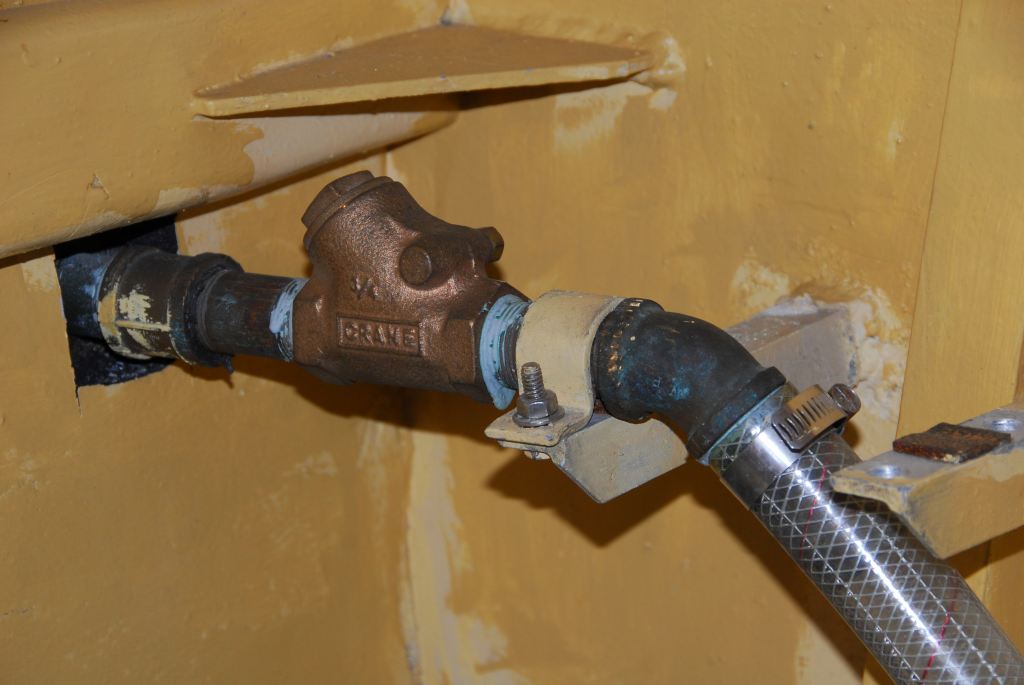
Somewhat less objectionable, this check valve is located at the point of discharge, where at least the water column issue is eliminated, it is being used in place of an anti-siphon valve, which is a violation of ABYC Standards. A riser and antisiphon valve would accomplish the same task with less risk.
Additionally, don’t use check valves to prevent back-flooding in systems with an overboard discharge manifold. In these systems, which are not uncommon, multiple pumps and other discharges drain into either a standpipe or a horizontal pipe(s) running the length of the vessel. Water must not be able to flow back out of any of these plumbing connections when any or all pumps are running, and a check valve cannot be used to accomplish this goal.
When I managed a boatyard, I instructed my technicians to use check valves in raw-water systems only as a last resort. In many cases, an antisiphon valve will achieve the same end with far less risk of failure. If a check valve is needed to prevent pump ‘short-cycling’, it’s best to use a non-metallic valve, and it should be thoroughly and regularly tested.

