
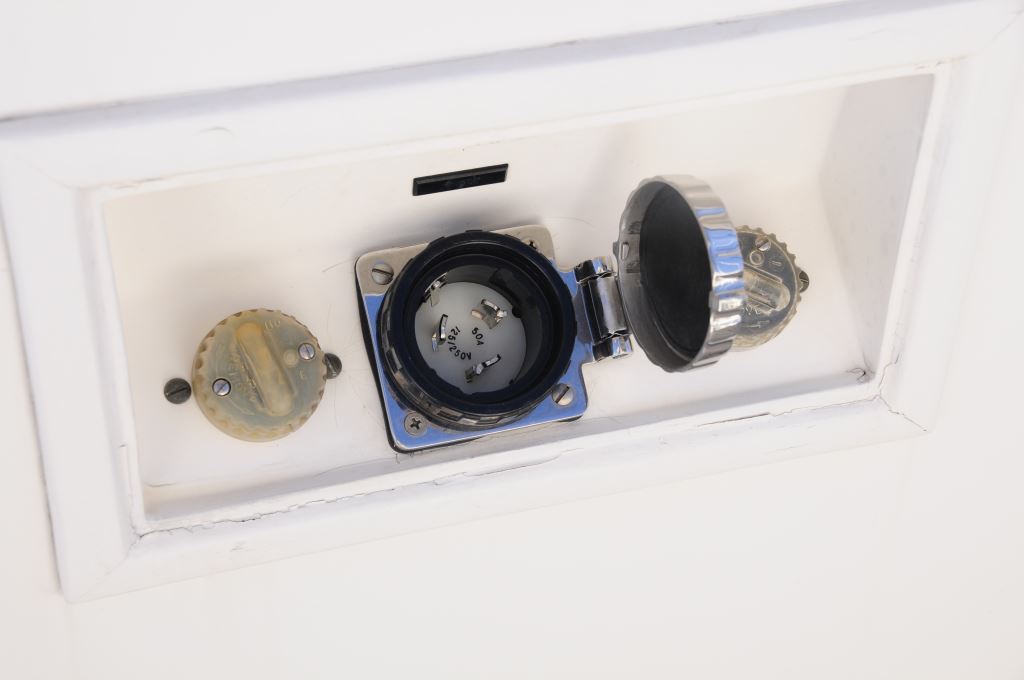
Photo Essay: Shore Power Over-Current Protection
Over-current protection, or OCP, a subject I write about all too often (most recently here), only because it is so critically important to fire prevention, is so frequently misunderstood. Contrary to popular belief, OCP’s primary goal is to protect wiring from being overloaded and overheating, rather than safeguarding devices and appliances.
The proper selection and placement of OCP depends on several factors, including the anticipated maximum load current, and the environment in which the OCP will operate. In addition to these criteria, the location of the OCP is also critically important. The ABYC Standard that dictates these guidelines, E-11, AC and DC Electrical Systems, provides clear guidance on this subject, which I have included in the above-linked article. For shore power applications, primary OCP must be located no further than 10 feet from the inlet; the closer the better. As I remind marine electricians regularly, just because the Standard allows OCP to be as much as 10 feet from the inlet, that doesn’t mean OCP should be 10 feet from the inlet. Every foot of wire between the inlet and the OCP, is potentially unprotected, and therefore presents a short circuit, or overload, fire risk.
Additionally, the primary shore power OCP must simultaneously break, disconnect, or open, L1 and Neutral, or the “hot” and neutral legs on a 120 VAC system, and both L1 and L2, of a 240 VAC or split phase (120/240 VAC) system, or both hot legs, simultaneously. This capability is achieved by using a two-pole, ‘simultaneous trip’ circuit breaker. These are identifiable by their permanently joined handles.
In the accompanying image, a 50 Amp, 120/240 VA, or “split phase” shore power inlet is shown. Its OCP is achieved using two individual fuses, in weather resistant fuse holders, one located on each hot leg, or L1 and L2. These fuse holders are attractive in that when a fuse blows, a small light in the cap will glow orange, alerting the user to the problem. Unfortunately, that’s where their benefit ends, as fuses fail to meet the simultaneous-trip requirement. Furthermore, while they are weather resistant, they often degrade as a result of exposure to UV light, which causes them to crack, and leak water into the current carrying path.
If your vessel uses such an arrangement, it should be abandoned and replaced with compliant, simultaneous-trip circuit breakers.
Ask Steve
Steve,
I was looking to bend your ear. I’ve heard over the years, you can’t use a non-marine generator on a swim platform of a boat to provide shore power to run AC’s, outlets, refrigerators, etc. With it being on the swim platform, it is still grounded via green grounding wire. And the exhaust is just flowing into the atmosphere. Is there an electrocution hazard that?
Would love your thoughts on that.
Logan Simpson
Logan:
Among other things, there are two primary issues with operating a portable gasoline genset aboard a vessel. The first is the risk of carbon monoxide poisoning. The exhaust from the genset may, under the right conditions, enter the vessel’s cabin, where it can accumulate. Some portable generators have a built in CO sensor, which will shut them down if a high enough concentration of CO is detected. However, that’s only effective in an enclosed space, like a garage for instance. If the exhaust from the genset is wafting through an open hatch, this safety feature is ineffective. Regardless, every vessel with an enclosed cabin should be equipped with CO detectors, even if there are no CO-producing devices aboard. CO poisoning is a potentially deadly scenario, which I’ve detailed in this article.
The second is electrical in nature. Assuming the vessel’s shore power was plugged into the genset, the “installation” would lack ABYC compliance; the Standards require that any source of AC power, a generator, inverter, or shore power transformer, have their neutral and grounding conductors connected, while it is the source of power. This arrangement ensures, or increases the odds at least, that fault current returns to the source of power, which in turn trips a circuit breaker, rendering the fault safe. If you had a permanently installed generator, the neutral and grounding conductors would be connected, assuming it was an ABYC compliant installation. Most portable generators do not have an internal neutral to ground connection. On the other hand, it is equally and critically important that neutral to ground connections not exist where they are prohibited, i.e., elsewhere aboard the vessel. More on neutral to ground connections, and where and where not to make them, here. Tellingly most portable generator manufacturers make no mention of use aboard boats.
Finally, handling and storing gasoline aboard, for the generator can, for obvious reasons, represent a safety hazard.
Steve,
As always, your articles are excellent and highlight real issues we face in boating.
A week ago, a crew finished a 10-day detailing effort on my 1994 Nordhavn 46. I wanted to protect the painted Non-Skid on the deck from absorbing bird stains in the hot CA sun so hesitantly purchased a Non-Skid spray on wax. Did a small section on the foredeck and it seems great as advertised it seals the paint without making it slippery. Then did the entire foredeck and Portuguese bridge flooring. It was amazing on the deck.
Sadly, I must’ve tracked it into our boat. Over the next few days, I noticed the varnished floor getting slippery as I wear only socks in the morning and evening when not working, on the bare floors. After the third day I was walking down the pilot house steps with a breakfast dish in one hand and the other hand on the railing. Next instant I’m on the floor.
My left arm scraped down the steps and has a bruise 2″ wide down the bone on the bottom of my forearm. The bruise was seen after the skin, removed from the abrasive sand strip on the steps, stopped seeping fluid and blood.
The bottom starboard rounded edge of the step ended up hitting my right kidney. Pain was similar to the kidney stone I keep having. If the rounded edge at hit me in my spine I think it might have broken my back.
With my phone up in the pilot house and me alone on the boat that would have been a bad situation.
The Non-Skid wax for the deck worked as advertised but the slipperiness inside the boat is crazy.
Now the issue is how to strip all the wax stuff off, everywhere, without ruining the detail job. But honestly, I care a lot more about not breaking my back. It’s been a week and the pain is still a bit high. Might have cracked the lower right rib but never went for an X-ray…too many fun boat projects to take the break.
Any suggestions on the wax removal inside the boat and on the painted deck?
On a totally different issue: The large dry exhaust stack cover on the top deck of the 46 has two large metal louvered side louvers. Any wind driven rain will be blown through the louvered grates and into the cover. I don’t see any drains at the very bottom of the cover as it is all sealed. There is a drain hole in the side but that is a tube connected to the top recessed section of the cover. I think I should remove a length of the sealant at the bottom so rain water can drain out. Also, the large louvers aren’t sealed against the cover but only screwed in place. Should the grates be sealed as well?
Thanks, as always.
Sincerely,
Harold Carrison
Harold:
You’ve shared a harrowing tale, one not unrelated to a recent editorial I posted here.
Waxing non-skid seems counter-intuitive, and I’ve never heard of non-skid wax, however, it seems this does exist.
There is a product that is designed to remove wax, adhesive and other contaminants from surfaces prior to painting, it’s called 3M General Purpose Adhesive Cleaner, it’s available in both liquid and spray format, however, I’ve only ever used the former. I have used this product for decades, and have never encountered an instance where it damaged an underlying coating or surface, so I believe it would be safe in this case. As always, test it first on a small, inconspicuous area.
As far as the stack drainage goes, I don’t believe removing the caulk would be adequate, dirt and debris would get clogged in this small gap. I can’t imagine Nordhavn built this stack in such a way that it could trap water. I would recommend posting this question on the Nordhavn Owners Group, to which, as an owner, you have access. If you need additional information on joining this forum, please let me know.
Hi Steve,
I’m upgrading my shore power system with an isolation transformer and an ELCI breaker. I’ve read the ABYC E-11 standards carefully and will follow them—including the use of Over Current Protection (OCP) after the transformer. I’m also going to follow your advice and install an ELCI breaker after the power comes on board even though the ISO will be within 10’ of the shore power inlet [exempting it from that ABYC requirement].
Since I have 50amp single phase shore power service, the grounded neutral is not connected at the boat. How does that work with the ELCI? Is the breaker only looking for a balance between L1 and L2 and ignoring the grounded neutral? And that leads to another question—why use a 6/4 shore power cord if the neutral is not connected at the boat? I haven’t seen any 6/3 cable that has the correct colors for an L1/L2/grounding conductor configuration, so I guess there is that—but it also seems like a waste of copper and weight to lug around a 6/4 cable when one of the conductors doesn’t seem to be doing anything.
Thanks.
Will Ritch
Will:
The ELCI you select will be a 240 VAC, 2 pole version, it is designed to work without a neutral, and yes, it measures an imbalance between L1 and L2, just as a 120 VAC ELCI measures an imbalance between L1/L2 and neutral. These are available from several well-known marine electrical retailers.
If you are utilizing an isolation/polarization transformer in your design, then you are correct, the shore cord’s neutral is unused unnecessary. With one very important caveat, you may, therefore, use a three-wire cord, which includes only L1, L2 and the safety grounding conductor.
A free-standing, 240 VAC shore cord, one that is devoid of a neutral, presents a serious risk of fire, if inadvertently used to supply power to a vessel that is not equipped with a shore power transformer. You should, therefore, only take this approach if the cord is permanently attached to the vessel, when using a cord reel system for instance.
Three-wire, 50-amp shore cord stock, with the correct color-coded conductors, is available from the best-known cord reel manufacturer, Glendinning.
If you have any doubts about the process, you should have an ABYC Certified Electrician check your work.

