
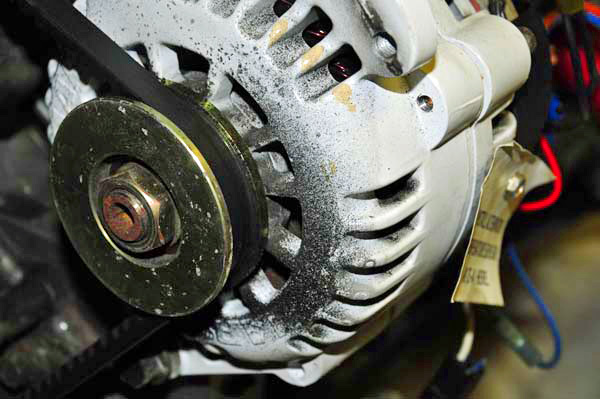
Photo Essay: Belts & Pullies
The internal combustion engine fan belt and pully arrangement has been around since the early 1900s, with the first “endless” V belt invented by John Gates, of the Gates Rubber Company. Since that time this design has been veritably perfected. Never the less, there are ways this system can go awry, and unsurprisingly many of the failure modes are user-induced.
Among the most common of errors is utilization of a belt that is incorrectly sized for the pulleys, sometimes called sheaves, as well as the use of mismatched pulleys. V belts transmit energy from a driven pulley, connected to the engine’s crankshaft, to driven pulleys such as alternator, circulation and raw water pumps. In order to transmit all of that energy efficiently, it’s critically important that the belt’s side walls fully engage the pulley’s valley walls, and that is only possible if belt diameter and height match the dimensions of the pulley. Too narrow, or too wide, and the contact surface between pulley and belt is reduced.
Adding to this issue is the all-too-common use of mismatched pulleys. This often occurs when a replacement alternator is installed, one with a pulley whose dimensions differ from the original. In that case, it becomes impossible to select a belt that fully engages all pulleys.
In the example shown here, this belt’s diameter is too narrow; it does not match that of the alternator pulley. As a result, it is slipping and shedding dust.
More on fan belts here.
Ask Steve
Steve,
I am replacing a 34-year-old, and failed, hydraulic bow thruster with a new 24V, ignition protected, electric bow thruster. Running large cables 30 feet to the engine room and back has obvious disadvantages and space is an issue. There is a lot of room for two Group 31 AGM batteries in the same compartment as the tube and thruster. This space is under the master queen berth.
Is it safe to install AGM batteries there knowing they could outgas small quantities of hydrogen if overcharged? If not safe, would a sealed battery box with a vent tube to the top of the vented anchor locker create a safe install?
Thank you.
Skip Wagner
Skip:
While it’s not uncommon, and it can be accomplished in an ABYC compliant manner, I’m no fan of sleeping on batteries if it can be avoided. If you do install a battery bank in this space, it must be, among other things, vented to allow hydrogen gas to safely leave the area under the berth (and the cabin). This can be accomplished by venting the under berth compartment at its highest point, or by venting an enclosed battery box, onto the deck. I also recommend smoke detection be included above all battery banks, regardless of chemistry.
If you decide to use batteries that are further away, your goal should be to achieve a maximum of a 10% voltage drop, and preferably 3%. This may require parallel conductors, the design of which are detailed in ABYC E-11.
Above all else, make certain you use ABYC compliant over current protection, and a readily accessible disconnect switch. More on over current protection here.
More on battery installations here.
Hi Steve,
We are having our boat surveyed and sea-trialed next week, and they want to perform a Wide-Open Throttle (WOT) test for a few minutes. I’m apprehensive about this since one engine is 33 years old with 3400 hours. The other engine has been rebuilt with 250 hours and isn’t a concern. I recently read your WOT article in Professional Boat Builder and wanted your perspective on my opinion.
It seems impractical to subject an older engine to a WOT test. It’s like expecting a 50-year-old man to follow a 20-year-old’s workout routine—it risks unnecessary strain or damage even if the older individual is healthy for their age. Similarly, running a 30-year-old engine at WOT creates stress it would rarely encounter in normal use, potentially exacerbating wear or triggering failures that may not have manifested otherwise. This risk compounds during multiple sea trials in a sale cycle.
Wouldn’t it make more sense to test an older engine based on its intended use, perhaps briefly pushing it to 80-90% of WOT? If the engine performs reliably under typical operating conditions, isn’t that a better measure of being “fit for purpose”? I’d appreciate your thoughts.
Best regards,
Sheldon Regular
Sheldon:
As the seller you have the full and unequivocal right to set the terms of the survey, and if you believe one engine is not safely capable of being operated at wide open throttle, you can stipulate that as one of the terms of the sale. Ideally, you would fully disclose that before accepting an offer, and at the very least disclose it well before, i.e. days, the scheduled sea trial.
Having said that, the old engine-old(er) man analogy, isn’t necessarily accurate, because engines don’t “age” per se, components wear out, and they can be serviced and renewed. The metallic components, the block, cylinder head, manifolds etc. don’t deteriorate strictly based on age, like the human body. They can suffer from, again, wear and corrosion, both of which can be reversed. You didn’t mention the brand, however, if it’s a diesel engine, many are capable of 10,000-hour lifespans, so by that measure you engine isn’t even middle-aged.
I routinely sea trial vessels with older engines, and I have been present during sea trials run by engine surveyors during pre-purchase scenarios. If, in reviewing the engine before the sea trial, I, or the engine surveyor, believe it has not been well-maintained, I recommend against a WOT run. Have I ever seen an engine failure during a WOT run, on an engine that otherwise appeared to be in good working order? Yes, and I can count these on one hand over nearly 40 years, and in those cases the WOT run exposed a latent defect, a scuffed piston, fouled ring, clogged oil port, sticking valve, worn bearing, etc.; precisely what a buyer wants to know before committing to a purchase.
A well-maintained engine, one that passes all the static and dynamic pre-WOT evaluations, should be fully capable of a WOT run, and doing so is important for two reasons. One, it ensures the cooling system is in good working order, and that the engine will not overheat. If an engine overheats at WOT, then it usually means it’s on the verge of overheating at an rpm just under WOT, i.e., which could be cruising rpm, and the problem is likely to migrate into the lower rpm range as time passes. Two, it ensures the propeller is properly matched to the engine; if it achieved the rated rpm at full throttle, then it means the prop pitch and diameter are likely correct. If the engine fails to achieve rated rpm, the WOT test should be suspended immediately, as it indicates there is an anomaly, which could include, among others, improper valve adjustment, worn piston rings, fuel injection or supply issues, excessive exhaust back pressure or incorrect propeller pitch/diameter. A proper sea trial evaluation should include measurement of exhaust back, and crankcase, pressure.
Again, if you are uncomfortable having a WOT test performed, make it clear that this is part of the terms of the survey/sale, doing so in advance will avoid a dispute on the day of the sea trial. If the buyer is uncomfortable with this stipulation, he or she has the right to not make, or withdraw, the offer.
More here…
Steve,
I am working on the plumbing design for the new boat for our non-profit and saw your article about how Schedule 40 PVC is not a good idea for raw water intakes and manifolds.
What about CPVC? It is listed on McMaster-Carr as able to be used with salt water and it is readily available. We are trying to minimize the amount of metal we use to avoid corrosion issues. If CPVC is not suitable, what would you recommend considering?
Thanks in advance.
Cheers,
Steve Richey
Steve:
While PVC pipe may be perfectly suitable for the conveyance of saltwater, it’s used for swimming pools and fish tanks after all, there is a significant difference between that, and its suitability for below the waterline or pressurized seawater scenarios, where a failure would lead to flooding and possible sinking.
Because PVC pipe, unlike fiberglass or glass reinforced Nylon, lacks reinforcement, it has a greater risk of fracturing, and if such a fracture can lead to flooding, that can be an issue. Also, unlike threaded components, if not assembled properly, glue joints can fail without warning.
The primary difference between PVC and CPVC is the latter’s ability to endure higher temperature, 200 F vs. 140 F, so no real advantage in this case unless you believe the plumbing will be subject to temperatures above 140F.
The PVC manufacturers I have spoken with all say their products are not designed for below the waterline plumbing, fresh or salt, if a failure would lead to flooding.
Some marine HVAC manufacturers use PVC for raw, and chilled, water system manifolds, however, these are generally carefully, and conservatively, engineered by these manufacturers, to prevent failures. Many are fully supported by a metal framework. PVC is also used by many water maker manufacturers, for various raw water plumbing components, however, once again those manufacturers have carefully selected and engineered those parts for reliability. A failure in any of these cases would risk the reputation of these manufacturers.
My recommendations for raw water plumbing are as follows.
- Non-metallic where possible, provided it has the necessary tensile strength and modulus of elasticity. Primary options include fiberglass and glass reinforced Nylon and polypropylene. McMaster and other sources offer off the shelf reinforced, non-metallic plumbing and manifolds.
- If metallic is used, it should be bronze and never brass. Leaded red brass is suitable provided the zinc content does not exceed 15%. More here. Avoid stainless steel, even 316L, as it will eventually crevice corrode. More on that here and here.
- If you opt for PVC, it should be schedule 80 and fully supported, i.e. attached to a continuous shelf or backing using a sturdy attachment method such as rubber lined metallic P clips; hoses attached to it should not impart significant loading, which means silicone, rather than stiffer EPDM, may need to be used.
- Raw water plumbing must be robust, if you can’t stand on it, it fails my own personal test.
More on the subject here.

