
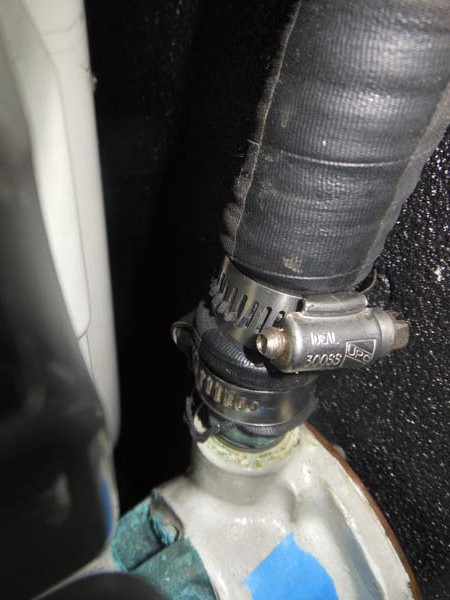
Photo Essay: When Two Hose Clamps Aren’t Better than One
There’s a saying in the military, ‘two is one and one is none’. This essentially translates to, ‘if you have one of something, when it fails, you’ll have nothing, so it’s best to have two’. Generally, this approach is applied to many, but not all, critical marine systems, from windlasses, and VHF radios to bilge pumps and primary fuel filters. When it comes to hose clamps, why wouldn’t you use two rather than one? For the cost, it’s cheap insurance. In fact, and this comes as a surprise to many boat owners, there are only two applications where double clamps are required for ABYC compliance; exhaust and fuel fill. While double clamps are desirable elsewhere, maybe even everywhere, with these two exceptions, they aren’t required, even in below the waterline, raw water scenarios.
In some cases, double clamps can actually be detrimental. In the example shown here, two clamps are used on a pipe to hose adapter associated with a raw water pump. The problem is, the adapter is too short for the second or upper clamp to apply any compression. Instead, that clamp is simply distorting and possibly damaging the hose; the perforations in the clamp’s band are ‘cheese grating” the hose’s jacket.
In short, feel free to use dual clamps (again, these are required on exhaust and fuel fill systems), provided both clamps will bear fully on the pipe to hose adapter. If the adapter is too short to support two clamps, and this is often the case on raw water pumps, then use just one high quality, preferably a solid band (more on that here) clamp, and inspect it regularly.
Ask Steve
Hello Steve,
Your name came up in a conversation on the American Great Loop Cruisers Association, about the use of different alloys for anodes. I’m not sure if you are a member there, but thought I would reach out to get your take on the debate.
The question is, if it is ok to use one alloy for an internal anode, say aluminum and zinc on the running gear. In the past, I know you recommended that they all be the same alloy, and I’m pretty much in agreement, but there are others who suggest that they consider say, the heat exchanger, to technically be in a different body of water, and therefore you could use a different alloy there. I’m not sure I 100% agree, since with an open through hull, if plastic or if using a bronze one, they are in effect in electrical contact with one another. If there is any electrical potential between, by perhaps a poorly bonded item in the system, then it could be possible for some protection being provided by the anode with more driving potential and this could lead to premature wasting of that anode. Perhaps this is a longshot and the difference between the two alloys isn’t really important.
Anyway, I’ve seen a lot of confusing information about this subject and thought it would be great to get your take, if you don’t mind sharing. I’m currently doing my own little test since I’ve just installed aluminum alloy pencil anodes in my boat, and all external are still zinc.
Thanks,
Laurence
Laurence:
I am not a member of the AGLCA, so I did not see this.
Generally, the “different bodies of water” argument is valid and one with which I am in full agreement; it is taught in the ABYC Corrosion Certification Class. Generally speaking, there are always exceptions, while there may be a “connection” via seawater, between hull and engine anodes, in fact the latter are too far away, and connected by too narrow a passage, to have any meaningful effect. In short, your engine anodes don’t protect underwater metals, and hull anodes don’t protect internal raw water-cooled gear like engines, gensets, hydraulic heat exchangers etc.
I’m an advocate for aluminum anodes in virtually all applications, so I recommend they be used everywhere, however, they are sometimes problematic in pencil anode applications, as they sometimes develop a “froth” (which is harmless and does not affect functionality), which can make them difficult to remove.
It’s not harmful per se to mix aluminum and zinc anodes, however, in practice, if used in a common system, and body of water, the aluminum anodes tend to be consumed first, and then the zinc, which is less than ideal.
More on the subject here.
Steve,
I have surveyed numerous boats that have outdated, or not maintained, fixed halon systems mounted in the engine compartment. Other than describing this situation in my survey report, I would like to know if there is a requirement to have it be functional. I don’t find any ABYC language to this effect. I would think insurance underwriters would care.
Do you have any insight on this?
Thank you,
Doug McEneany
Doug:
Fixed fire extinguishing systems, particularly those located in engine compartments, are among the areas where I frequently encounter errors or outright violations, of both ABYC and system manufacturer guidelines, and as a result they should receive careful scrutiny.
Requirements for the installation and maintenance of these systems is covered in ABYC’s chapter A-4, “Firefighting Equipment”. You should cite this standard when making observations and recommendations related to these systems. The specifics are as follows; the highlights are mine.
4.8 REQUIREMENTS – FIXED FIRE EXTINGUISHING SYSTEMS
4.8.1 CO2 shall not be used in fixed fire extinguishing systems on recreational craft.
EXCEPTION: Boats with engine compartments over 6,000 ft3 (167 m3) with manual operation.
4.8.2 Fixed fire extinguishing systems shall be capable of both automatic and manual operation.
EXCEPTION: Boats with engine compartments over 6,000 ft3 (167 m3) with manual operation.
4.8.2.1 As installed, a manual release device shall be readily accessible and operable using a maximum force of 22.48 lb (100 N). A label showing how to discharge the system shall be provided adjacent to the release device, with the protected spaces identified. A means of preventing accidental discharge shall be provided.
4.8.3 Fixed fire extinguishing systems shall be installed, maintained, and inspected in accordance with the fixed fire extinguishing system manufacturer’s instructions.
NOTE: Fixed fire extinguishing systems should be installed as high as practical and as far from natural and mechanical ventilation as possible.
For diesel-powered vessels, there is a further requirement for an automatic shutdown component.
4.8.4.3 DIESEL BOATS
4.8.4.3.1 The system shall be designed and installed so that the engines, generators, and blowers located in the protected space shut down automatically.
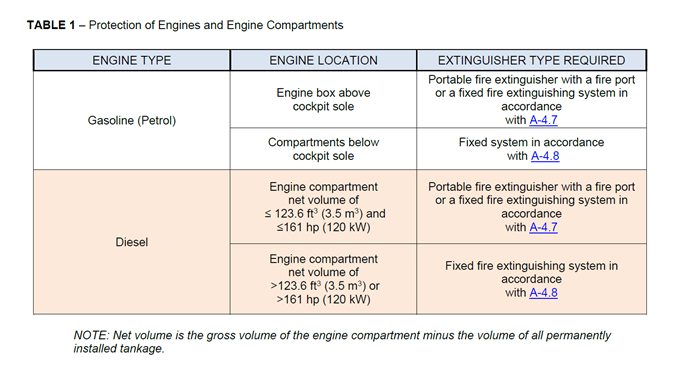
More on fixed firefighting systems here.
Dear Steve,
A quick question, regarding a Nordhavn 46.
My yard says the bottom paint has failed down to the initial layer. They want to “media blast” the hull and prime it, and add several layers of epoxy, then finally bottom paint. I have only owned the boat two years, but I don’t question the assessment of the status of the paint. The yard estimates 20-25K, and that is my question… The yard does good work, but this estimate seems high.
I previously owned a sailboat of the same length and did not see that high an estimate in that work. In fairness, I don’t recall if soda, or whatever, blasting was involved with the sailboat.
The yard did say if I don’t want to do the job, I should do nothing this coming summer, as sanding spots and painting would be useless.
Thank you,
Michael Barrett
Michael:
For a vessel of this age, it’s entirely possible the initial application of antifouling paint is releasing. In fact, it’s possible it’s been stripped before and this is now the second generation of anti-foulant that is releasing, necessitation full removal back to gelcoat. Anti-fouling paint applications can be expected to last 10-15 years before stripping is required, and this is more likely if hard, non-ablative paint is used.
Ideally, a new bottom, or one that has been stripped, should be profiled so it is slightly rough gelcoat or fiberglass, rough enough so the primer/barrier, more on that in a moment, has something to which it can mechanically adhere. There’s more than one kind of blasting; sand or blasting media such as Black Beauty, should never be used on fiberglass, as it is too aggressive and can leave the bottom wavy and unfair. Baking soda, kieserite and other less aggressive slurry (it’s mixed with water) media usually do a good job of removing paint, while leaving a smooth but slightly rough surface.
You mentioned the yard said they intend to prime and add several layers of epoxy. Typically, an epoxy barrier/primer (the number of coats determines which it will be) is applied, and then anti-fouling paint, rather than primer and an epoxy coating, so you might want to get clarity on that. Barrier coats, which are used to prevent hulls from absorbing water, which can lead to osmotic blisters, typically require additional applications, to achieve the necessary mil thickness. If the hull is made using polyester resin, then it’s wise to take the barrier coat approach since polyester resin is susceptible to osmosis. If the hull is made, or at least “skin coated” (the outer 2-3 layers) using vinylester resin, then only a primer thickness, i.e. fewer coats, is needed. I’m not certain if any or all N46s were vinylester skin coated, you could pose that question to Nordhavn.
In some cases, the manufacturer of the primer/barrier coat recommends application of the first coat of anti-fouling paint within a ‘chemical bonding window’, allowing for a very tenacious interface between the two coatings. More on that subject here.
You didn’t mention where this work will be done, however, fees can vary considerably based on geography. You might ask for a written description of the work, sub-contractor fees (for blasting if the yard does not do this themselves) and labor rate to better understand what will be delivered.

